-
-
-
-
-
-
-
-
-
-
-
-
-
-
-
-
-
-
-
-
Dunedin & Coast FMU
-
-
-
-
-
-
-
-
-
-
-
-
-
-
The Dunedin & Coast Freshwater Management Unit spans more than 1,000 square kilometres, from just south of Karitāne to the mouth of the Clutha/Mata-Au. Dunedin city is the largest urban area and has the largest population in Otago.
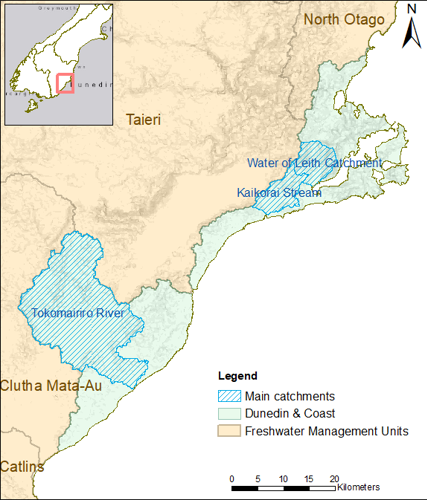
Average rainfall is 738mm per year. Main catchments are the Waitati River, Leith Stream and Kaikorai Stream catchments within Dunedin city and the Tokomairaro (Tokomairiro) River in the south.
The area has a marine-temperate climate and outstanding features, including natural coastal landscapes like the Otago Peninsula; ecological values, such as the cloud forests of the Leith Valley and the area around the Ōrokonui Ecosanctuary; healthy estuaries like Hoopers/Papanui, Blueskin, Akatore, Pūrākaunui; wetlands like Swampy Summit Swamp; notable wildlife such as the hoiho, northern royal albatross, seals, sea lions, red-billed gulls and black-billed gulls; and healthy marine habitats. It is also home to threatened species, including lamprey in coastal streams.
Māori settlement dates back to around 1250 AD, with moa supporting a growing population. The Otago Harbour and rivers, estuaries and lagoons in the Dunedin coastal area were significant mahika kai (gathering resources) that supported numerous Kāi Tahu settlements.
The whaling industry, then the gold rush in the mid–1800s, attracted many Europeans (mainly Scottish) and led to the establishment of Dunedin city.
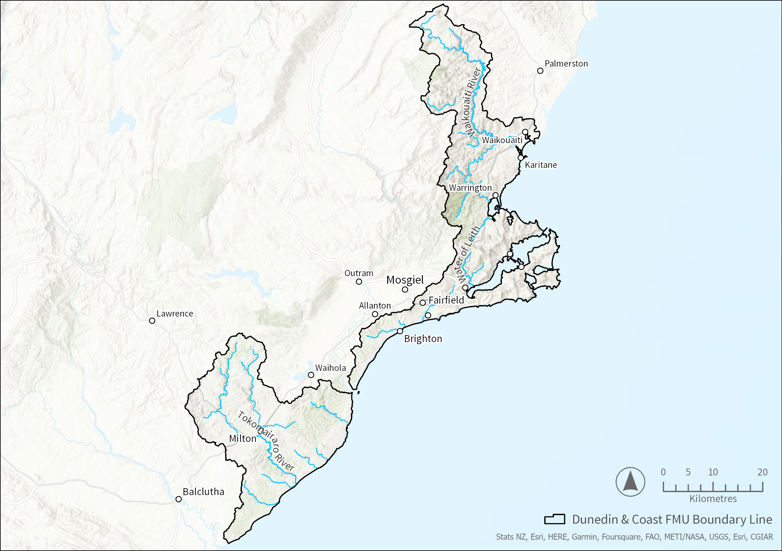
Freshwater policies for the Dunedin & Coast FMU can affect environments beyond the FMU boundary. Hence the rest of the Dunedin city area (including Mosgiel and the surrounding area up to Middlemarch, which are part of the Taieri FMU but are less than an hour’s drive from Dunedin city centre) are combined with the Dunedin & Coast FMU when presenting socio-economic information. This combined area is referred to as Dunedin and surrounds.
In 2018, the Dunedin and surrounds area was home to around 130,000 residents (or nearly 60% of Otago’s population). In the 12 years between 2006 and 2018, the population increased by 7% (or 8,100 people). This is lower than the increase for the Otago region (+16%) and New Zealand (+17%). Most residents (nearly 80%) live in Dunedin City centre area, while the remainder are split between Mosgiel and the surrounding area (10%), and smaller towns and rural areas (10%).
Nearly two in three Otago residents’ livelihoods directly rely on the water resources in this FMU, from domestic water consumption and discharge to commercial and industrial water use and discharge.
The economy in Dunedin and surrounds is more diverse than other parts of the Otago region. Residents mostly work in tourism-related industries, health care and social assistance, education and training, construction, or public administration and safety. Employment in the primary sector is relatively small, providing around 2% of jobs. The large residential population and approximate two million visitors annually (pre-COVID 19) are increasing the pressure on water use (water takes and discharges of pollutants or contaminants to water) and its infrastructure.
An understanding of Māori history and the Māori economy is essential for developing policy and assessing its impact. Pre-European Māori history shapes today’s Aotearoa, and the Māori economy is integral to the national economic system. A report prepared by Aukaha, with support from ORC, provides a Kāi Tahu assessment of the socio-economic impacts of freshwater management in Otago.
The main land use in the Dunedin & Coast FMU is plantation forestry (28%). A significant portion of this FMU is used for dry stock farming, including sheep and beef (19%), mixed sheep, beef and deer (4%), beef (5%) and sheep farming (8%). Dairy farming takes up close to 8% of the area, and around 7% is for urban use.
Notable trends in land use change over the past 30 years are an increase in dairy farming by 38%, public conservation estate by 55%, plantation forestry by 19%, and urban land use by 4%. Dry stock farming has decreased by 14%, although it remains one of the main land use activities in the FMU.
Brown soil covers 48% of the area, and Pallic soil covers 39%. This includes the north and south of Dunedin city and most of the Tokomairaro catchment. Brown soils are well-drained with moderate permeability and found mostly in plantation forests. Pallic soils have poor drainage and moderate to slow permeability and are mainly used for high-producing grasslands. Melanic soils are mainly around the Otago Harbour, are well-drained, and have moderate to rapid permeability.
Dunedin & Coast land use summary
Surface water use in this area is relatively low. To the north of the FMU, Dunedin city water supply includes water take consents on the Leith and Waitati catchments, but these takes are now only for emergency supply and are not currently used. Most of the city’s water supply comes from the neighbouring Taieri FMU. In the southern part of the FMU, surface water is used for dairy sheds and stock water, mining and landfill activities, rural domestic water supply, and a small amount of irrigation.
Water quality is monitored at eight river and stream sites, and ecological monitoring is at three river sites in the FMU.
This monitoring shows high bacteria and nutrient concentrations at every site other than the Waitati River. Nutrient concentrations are highest in the urban streams.
The Water of Leith, Kaikorai Stream and Tokomairaro all have degrading nutrient concentrations over the long term but have improved in the the last 10 years.
Of the four sites monitored for aquatic health, two (Kaikorai and Lindsay’s Creek) do not meet the required standard for the Macroinvertebrate Community Index (MCI). This is likely to be because of the urban environment.
Dunedin has large areas of hard surfaces for parking, which require a network of stormwater drains. These drains discharge contaminants, which often have high bacteria and nutrient concentrations, into local rivers and streams.
Dunedin & Coast FMU Water Quality State and Trends Technical Report
LAWA Macroinvertebrate Community Index (MCI)
Introduction to water quality
Dunedin & Coast water quality summary
Groundwater use is low. The primary groundwater resource is the Tokomairaro Groundwater Management Zone, which is mainly used for domestic supply, stock water, irrigation, and dairy sheds. The consented allocation is a small proportion of the current Mean Annual Recharge. This FMU has only one monitoring bore, which generally shows good groundwater quality, with low E. coli and nitrates.
Dunedin is known as the “wildlife capital of New Zealand” due to the rare and endangered species near the city and has areas of outstanding biodiversity, including the Otago Peninsula, a renowned wildlife and eco-tourism destination, and Orokonui Ecosanctuary, a wildlife reserve with rare species including forest birds, reptiles, and plants.
Rare and threatened freshwater ecosystems within the FMU include lagoons, dune slacks, estuaries, and wetlands. These ecosystems are often threatened by land use change and invasive species. We know little about the extent and/or condition of these ecosystems.
The Dunedin & Coast FMU has many species that depend on freshwater habitats, including fishes, invertebrates, plants and birds, among which are 44 threatened species. Native freshwater fishes are three non-migratory galaxias, four migratory galaxias (whitebait), two eel and five bullies. The lamprey and all non-migratory galaxias in this FMU are threatened.
Freshwater invertebrates are koura, shrimp, and mussels. Threatened freshwater-dependent plants are Crassula peduncularis and Carex strictissima.
Many native birds depend on freshwater ecosystems as permanent or mobile residents, including the threatened Australasian bittern and the at-risk black-billed gull. We lack information at a species level, particularly for freshwater invertebrates, non-vascular plants and algae.
Exotic fishes are goldfish, perch and four salmonids. Many native freshwater species are under threat and continue to decline.
Natural wetlands in the Dunedin & Coast FMU are mainly associated with estuaries and lower reaches of rivers and streams. Flaxlands are the most common wetland vegetation type with oioi restiad rushland widespread in coastal wetlands and carex in upland areas. The wetlands are generally small and scattered along water courses and around the coast. The Okia Flat wetland and the Tokomairaro River Swamp are the largest wetland systems, both over 170 hectares.
Within the Dunedin & Coast FMU 16 sites are recognised as Regionally Significant Wetlands. These are presently classified as swamp (8 sites), several grading to salt marsh (2), marsh (4) and bog (1).
Starting with the bog site, the flat crest of Swampy Summit (48 hectares) holds several tarns with margins of sphagnum bog grading to tussock and shrubland. The substrate is peat, which in places is exposed as dried, wind-eroded surfaces that reveal subfossil stumps of a former pink pine woodland, as well as quartz pebbles derived from moa gizzard stones. These are both indications of the bog’s history and changes over time for its flora and fauna.
There are also bog communities in stream heads to the east of Swampy Summit, in basins that have up to six metres of peat, along with communities of sphagnum, carex sedgelands, mountain flax, surrounded by subalpine scrub and regenerating cedar cloud forest.
One other bog site is recognised: Black Swamp, an isolated six hectare dome of peat on a ridge crest inland from Milton. This site has wire rush, sphagnum and sedge communities, and heath scrub of manuka and dracophyllum in surrounding farmland.
Coastal wetland sites that have not yet been identified in the Dunedin & Coast FMU are those of Pūrākaunui Inlet and Blueskin Bay (including the Orokonui arm).
The latitudinal distribution limits of plants are interesting – for example, species that are more common in northern New Zealand come south only as far as they can tolerate the cold, so sea rush (Juncus kraussii), reaches itssouthern limit in Pūrākaunui Inlet, and the tall sedge Bolboschoenus caldwellii at Tomahawk Lagoon.
This FMU has seven estuaries, with natural or modified ecosystems depending on surrounding land use. The Tokomairaro and Kaikorai estuaries are the most affected by sedimentation and increases in nutrients due to upstream land use and are in a “fair” and “poor” state, respectively.
The Kaikorai Estuary has experienced high modification and habitat loss due to urban development. The Blueskin Bay catchment is less modified, with native and plantation forests and low-intensity agriculture. Because of this, the estuary is in a “good” state, although it is vulnerable to habitat loss and modification of estuary margins.
Papanui and Hoopers inlets both have large seagrass beds — a good sign of estuarine health. However, like all estuaries, they are susceptible to human activity and vulnerable to modification.
The Dunedin & Coast FMU also contains several coastal lagoons. Little is known about most of these ecosystems. The Tomahawk Lagoon is a regionally significant wetland and wildlife sanctuary under stress from nutrient and habitat alteration. It experiences harmful algal blooms.
October 2022
PDF | 550 KB
November 2022
PDF | 2 MB

September 2024
Aukaha (1997) Ltd
PDF | 4 MB
This report provides a Kāi Tahu assessment of the socio-economic impacts of freshwater management in Otago, which speaks to the development of a new Land and Water Regional Plan for Otago (LWRP).
Contact your FMU's Catchment Advisor for advice and assistance on sustainable land management practices that protect Otago’s waterways.
Sign up to our monthly newsletter On Stream for regular updates
Email customerservices@orc.govt.nz
Tel 0800 474 082


