Endemic species are indigenous species whose natural distribution is restricted to a particular geographic area and which occur naturally nowhere else in the world.
Aotearoa New Zealand has an exceptionally high level of endemism. Approximately 52% of named species are endemic, including about 32% of freshwater species, 39% of marine species and 68% of terrestrial species. Its long geographic isolation, varied landscapes and range of climates have allowed many species to evolve here that are found naturally nowhere else in the world.
Endemism can occur at different geographic scales. A species can be endemic to Aotearoa New Zealand while occurring widely across the country, or it can have a much more restricted distribution within a particular region.
The tūī (Prosthemadera novaeseelandiae) is a bird species endemic to Aotearoa New Zealand. It occurs across much of the country, including Otago, but does not occur naturally elsewhere in the world.
The longfin eel / tuna (Anguilla dieffenbachii) is another example. It occurs naturally in freshwater systems throughout the country, including Otago’s rivers, streams, lakes and wetlands. Adults migrate to the Pacific Ocean to spawn before young eels return to Aotearoa New Zealand waters. This life cycle extends beyond Aotearoa New Zealand, while the species’ natural freshwater distribution is centred here.
The northern royal albatross / toroa (Diomedea sanfordi) is also endemic to Aotearoa New Zealand. It breeds only in New Zealand, including at Pukekura / Taiaroa Head on the Muaūpoko / Otago Peninsula, the only mainland breeding site for an albatross species in the Southern Hemisphere, and on islands in Rēkohu / Wharekauri / Chatham Islands. Although its breeding distribution is restricted to New Zealand, it spends much of the year at sea and travels widely across the Southern Ocean.
Together, these examples illustrate that New Zealand endemic species can have different natural distributions within the country, while some also travel beyond New Zealand during their life cycle.
A regional endemic is a species whose natural distribution is restricted to a particular region within a larger landmass. In this case, the region is Otago within Aotearoa New Zealand.
Regional endemic species in Otago are those known to occur naturally only within the Region. The Cromwell chafer beetle (Prodontria lewisi) is one of the best-known examples. It is a flightless beetle restricted to Central Otago and is therefore a regional endemic of Otago.
More than 450 species have been identified as regional endemics of Otago.
Otago’s regional endemics occur across a wide range of environments, including alpine areas, river valleys, dryland, freshwater and coastal habitats.
Some are closely associated with specialised habitats, including naturally uncommon ecosystems. For example, salt-pan cress (Lepidium kirkii) grows in inland saline areas with saline and sodic substrates, while Pisa Flats woollyhead (Craspedia argentea) grows on inland outwash gravels. Their distributions are linked to the limited occurrence of these specialised environments.


Others occur across broader areas of Otago. The Otago skink (Oligosoma otagense) occurs across parts of inland Otago, while Cromwell broom (Carmichaelia compacta) occurs in several areas of Central Otago. These species show that being endemic to Otago does not necessarily mean being confined to a small area.


Otago’s regional endemics span six species groups: invertebrates, indigenous vascular plants, freshwater fishes, reptiles, bryophytes and birds.
More than 400 regional endemic invertebrate species were identified. These include spiders, flies, beetles, moths, mites, wasps, bees and ants, true bugs, stoneflies, caddisflies, wētā, grasshoppers and harvestmen.
Examples include:
Cromwell chafer beetle (Prodontria lewisi) — a flightless beetle restricted to Central Otago.
Megadromus fultoni — a flightless ground beetle associated with rocky soils.
Oregus inaequalis — a ground beetle recorded from coastal Otago.
Prodontria modestra — a flightless beetle associated with dryland environments in Otago.


39 regional endemic indigenous vascular plant species were identified, representing 14 botanical orders. The largest groups are Asterales (11 species), Boraginales (7) and Poales (7), with the remaining 14 species spread across 11 other orders.
Examples include:
Salt-pan cress (Lepidium kirkii) — associated with the inland saline ecosystem.
Cromwell broom (Carmichaelia compacta) — associated with dry rocky landscapes in Central Otago.
Pisa Flats woollyhead (Craspedia argentea) — associated with the inland outwash gravel ecosystem.
Lindsay’s daisy (Celmisia lindsayi) — associated with coastal habitats in southern Otago.


Nine regional endemic freshwater fish species were identified. All are galaxias species.
Examples include:
Central Otago roundhead galaxias (Galaxias anomalus) — associated with waterways in Central Otago.
Taieri flathead galaxias (Galaxias depressiceps) — restricted to the Taieri River catchment.
Eldon’s galaxias (Galaxias eldoni) — found in parts of the Clutha River catchment.
Nevis galaxias (Galaxias “Nevis”) — restricted to the Nevis River catchment.
Six regional endemic reptile species were identified. These include three skinks and three geckos, many of which are associated with rocky and dryland habitats.
Examples include:
Otago skink (Oligosoma otagense) — one of Aotearoa New Zealand’s largest skinks, reaching around 30 cm in length, with black upper surfaces and contrasting lighter markings. Natural populations occur around Lindis Pass and Lake Hāwea in the west, and Macraes Flat and Middlemarch in the east. A translocated population is also found at Orokonui Ecosanctuary – Te Korowai o Mihiwaka.
Grand skink (Oligosoma grande) — slightly smaller and more slender than the Otago skink, with deep black colouring and fine golden flecks and streaks. Currently known from Lindis Pass and Lake Hāwea in the west, and Macraes Flat and Middlemarch in the east.
Burgan skink (Oligosoma burganae) — a small alpine skink restricted to the Rock and Pillar and Lammerlaw Ranges in inland Otago.
Raggedy Range gecko (Woodworthia “Raggedy”) — a brightly marked gecko that is only known from the northern Raggedy Range in Central Otago.
Schist gecko (Woodworthia “Central Otago”) — a grey or brown gecko with patchy colouring that blends into the schist tors of Central Otago.
Kawarau gecko (Woodworthia “Cromwell”) — a medium-sized gecko associated with rocky habitats and active during both day and night.
Kawarau gecko (Woodworthia “Cromwell”) — a gecko with grey-brown colouring found in inland Otago, occurring in the Dunstan, Cairnmuir and Old Woman Ranges, as well as around Queenstown and Wānaka.
One regional endemic bird species was identified. The Otago shag / matapo (Leucocarbo chalconotus) is a coastal species whose current breeding distribution is restricted to Otago.
Example:
Otago shag / matapo (Leucocarbo chalconotus) — a primarily coastal shag that breeds along the Otago coast, particularly around rocky cliffs and offshore islands.

Endemic species vary greatly in the size of their natural ranges. Some occur across relatively large areas of Otago, while others are restricted to very small areas, such as a single island or mountain. Some are closely associated with specialised environments, such as inland saline sites.
Species can develop adaptations to the environmental conditions in which they live. These may include distinctive physical characteristics, behaviours or physiological traits that help them survive and reproduce. For example, species living in dry inland environments may be adapted to low rainfall and large seasonal temperature differences, while alpine species must cope with cold temperatures, snow and short growing seasons.
A restricted distribution does not necessarily mean that a species is rare. Some regional endemics can be locally common within their natural range. However, species with small distributions can be particularly vulnerable if the places they depend on are lost, modified or affected by environmental change, including human-induced climate change.
Although endemic species are often overlooked, they are an important part of Aotearoa New Zealand’s natural heritage and contribute to the biodiversity and functioning of ecosystems.
They can play important roles in ecological processes such as pollination, seed dispersal, nutrient cycling and predator-prey interactions. Because they occur naturally in a limited geographic area, the loss of an endemic species represents a loss of biodiversity that cannot be replaced by populations elsewhere.
Endemic species can also contain unique genetic characteristics that contribute to scientific understanding and may have potential value for research, including studies of adaptation and resilience to environmental change.
Regional endemism is particularly important from a conservation perspective because a species found only in Otago has no other natural population elsewhere in the world.
More than 450 species have been identified as regionally endemic to Otago, of which approximately 270 have been assessed nationally under the New Zealand Threat Classification System. Of these assessed species, approximately 85% are classified as Threatened, At Risk or Data Deficient, indicating that they face an identified risk of extinction, are considered at risk of becoming threatened, or have insufficient information to determine their level of risk.
Protecting Otago's regional endemic species begins with improving our understanding of their distribution, populations and the environments they depend on. For many species, information about their current distribution and population size is limited.
Improving this knowledge can help identify important areas, guide ecological monitoring and support more targeted conservation management. Protecting and restoring native ecosystems can also benefit multiple endemic species and the wider communities they are part of.
Where information is available, conservation actions may include maintaining existing populations and their environments, restoring habitat, controlling predators and weeds, or monitoring populations to better understand changes over time.


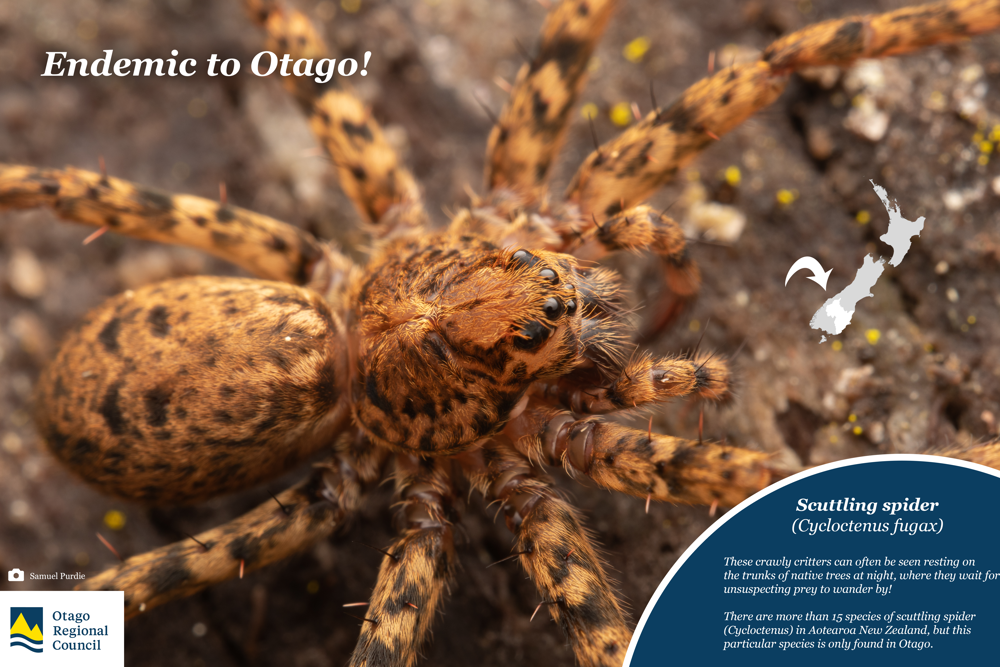
There are more than 15 species of scuttling spider (Cycloctenus) in Aotearoa New Zealand, but this particular species is only found in Otago.
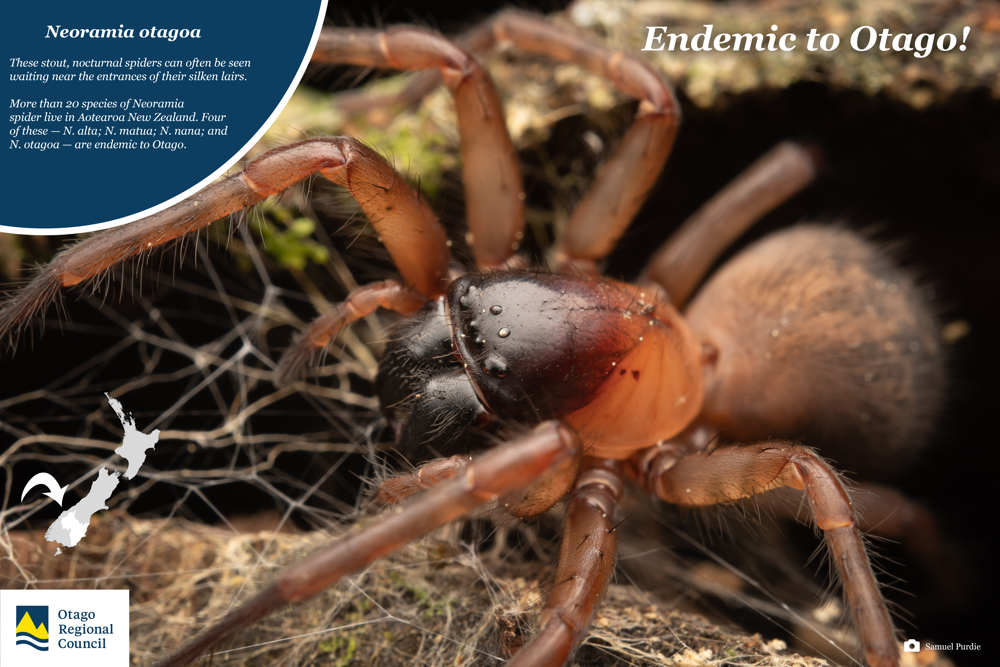
Find out more about the regional endemic species here:


Explore the species in Otago
Our indigenous species and their habitats are a taoka (treasured possessions).

Otago’s lists of selected species
We have published species lists for many of the native species found in Otago.

Conservation status
We have published threat assessments on several group of species in Otago, including bats, birds, indigenous vascular plants and reptiles. You can read them all on our regional threat assessment page, with more to come.
Have you spotted a regional endemic species? Take a photo or audio recording and upload your observation to iNaturalist, including the location and date. Your observations can help improve our understanding of where regional endemic species occur across Otago.


